
Key takeaways
- Dolan Memory Care Homes has been family-owned and locally operated in St. Louis since 1993, so the people making decisions live in the same community as the families we serve.
- Our 17 homes, grouped into seven neighborhoods, are small single-story ranch homes with 6 to 11 residents each, a different setting from a large multi-unit building.
- Care Partners get to know each resident’s stories, routines and preferences, and our nurses are on site 7 days a week.
- Pricing is all-inclusive and private pay: every resident pays the same rate, and rates do not increase as care needs grow.
- The right choice depends on your loved one and your family, so this guide offers neutral questions you can ask any memory care community.
Introduction
If you are searching for memory care in St. Louis, or typing “memory care near me” late at night after a long day, you have probably noticed how different the options look. Some are small, locally run homes. Others are large communities operated by national companies. This guide looks at Dolan memory care vs national chains in a fair, plain way, because bigger is not always better in memory care, and smaller is not automatically right for every family either.
First, a quick answer to a question many families ask: what is memory care? Memory care is long-term residential care for people living with Alzheimer’s disease and related dementias. It typically includes specially trained caregivers, a secure environment, and daily routines built around memory loss. The Alzheimer’s Association offers helpful general background on care types. Within that definition, communities can look very different from one another, and our goal here is to help you see those differences clearly so you can choose with confidence.
The small-home model vs the large-facility model
The most visible difference is the setting itself. Dolan cares for residents in small residential homes. Each of our homes welcomes 6 to 11 residents, and every home is a single-story ranch of roughly 7,000 square feet. Our 17 homes are spread across seven neighborhoods: Conway, Frontier, Mason, Schuetz, Villa Dorado, Les Maisons and Waterford Crossing. Founder Tim Dolan created Les Maisons, a neighborhood described as a first of its kind in Missouri.
These homes are purpose-built for dementia. They offer calming spaces and secure outdoor areas, with no long hallways and no elevators. A resident can step onto a porch, walk to the kitchen, or find a quiet corner without crossing a large building. For many families, the scale is what makes a place feel like a home instead of an institution.
Larger communities are built differently, and that is simply a matter of design. They are often multi-story or multi-wing buildings that house many residents under one roof, with shared dining rooms, long corridors and more people coming and going each day. Some families value the range of amenities and activities that come with scale. Others find that a quieter, smaller setting suits their loved one better.
Neither model is right for everyone. What matters is how your family member responds to noise, distance and change. If you would like to see what a small-home setting looks like in person, you can find our homes and read more about our care approach.
People: Care Partners and continuity
In memory care, the relationships matter as much as the building. At Dolan, caregivers are called Care Partners, a name that reflects how we see the work: walking alongside each resident and each family, not simply completing tasks.
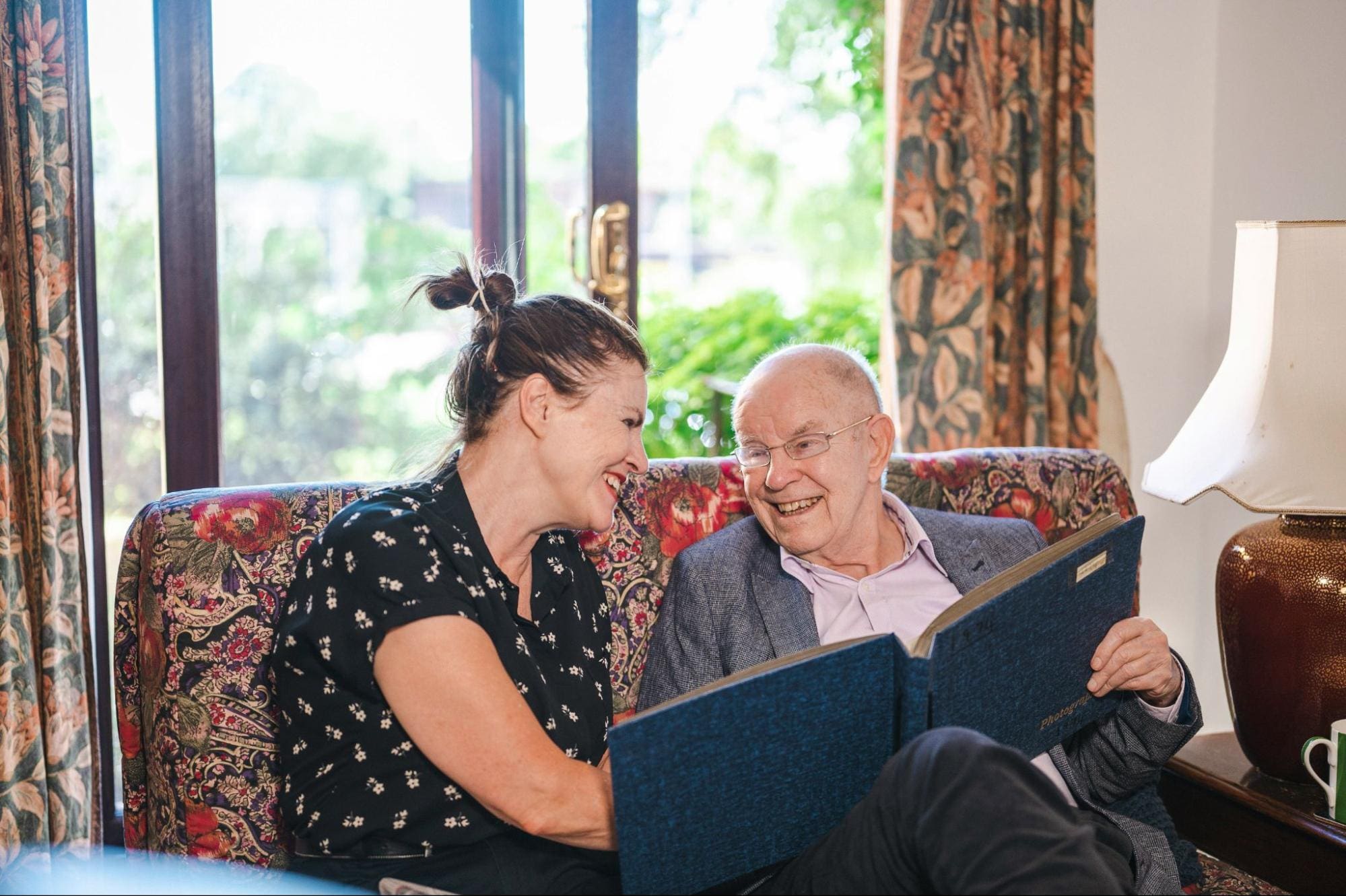
Because our homes are small, Care Partners spend their days with a handful of residents rather than a large census. That makes it possible to learn what each person is like: the stories they love to tell, how they take their coffee, which song brings a smile, and what time of day feels hardest. Knowing someone well helps a Care Partner respond with patience instead of correction, and it helps families feel that their loved one is seen as a person first.
Continuity is a quiet part of this. Dolan’s leadership and care teams are long-tenured, and we place real value on stability and experience. When the same familiar faces greet a resident each day, trust has room to grow. Our team includes registered nurses, social workers, certified medication aides and nursing assistants, and our nurses are on site 7 days a week. Our Care Partners and nurses receive specific training from the Alzheimer’s Association in the care of Alzheimer’s and related dementias.
When you visit any community, it is worth asking how long team members have been there and how well they know the residents. You can meet our Care Partners to see who would be caring for your loved one.
Ownership, pricing and local roots
Who owns a community shapes how it is run. Dolan has been family-owned since 1993, which means more than 30 years of local ownership and operation, and every decision is made close to the homes themselves. We have been serving St. Louis families for over three decades, and our neighbors are the people we care for, work alongside and see around town. For a family, that closeness can mean knowing who to call and having that person know your name.
Pricing structures also differ across memory care communities, and understanding them early can prevent hard conversations later. Some communities set rates in tiers that change as care needs change. Dolan uses all-inclusive pricing. Every resident pays the same rate regardless of how much care he or she receives, and rates do not increase as care needs grow. Dolan is private pay, and our team is glad to walk you through the details by phone. We do not publish prices on this page because every family’s situation deserves a conversation, not a number on a screen.
If cost is on your mind, our guide to the cost of memory care explains the questions to ask. And if you would like to understand our philosophy of warmth over luxury, read about the Dolan memory care difference.
Our local roots also show up in daily life. Residents enjoy porches, walks in the park, music therapy, clubs and weekly outings, all designed around familiar routines and community connection.
How to decide what fits your family
There is no single right answer, and the best choice is the one that fits your loved one’s personality, needs and comfort. Whether you are comparing a local specialist, a national operator or several of each, these neutral questions can help:
- Setting: How many residents live together? Is the space single-story, quiet and easy to navigate? Is outdoor space secure?
- Care Partners: How well do team members know each resident? How long have they been there? What dementia-specific training do they receive?
- Nursing: How often are nurses on site, and what is the schedule?
- Ownership: Who owns and operates the community, and how long have they been in St. Louis?
- Pricing: What is included in the rate? Does it change if care needs grow? Is it private pay?
- Daily life: What does a typical day look like? Does it feel warm and familiar, not rushed?
- Your gut feeling: When you walk in, does it feel like a place your loved one could call home?
The best way to answer these questions is to see a community yourself, ideally at different times of day. Take your time, bring family members who know your loved one well, and trust what you notice.
Frequently asked questions
How is a small memory care home different from a large facility?
A small memory care home is a residential house where a handful of residents live together, usually with a calmer rhythm and closer relationships with Care Partners. A large facility is typically a bigger building with many residents and multiple floors or wings. At Dolan, each home welcomes 6 to 11 residents in a single-story layout with secure outdoor areas, no long hallways and no elevators.
Is Dolan a national chain?
No. Dolan Memory Care Homes is family-owned and locally operated in St. Louis, and has been since 1993. Our 17 homes are in St. Louis County neighborhoods, and the decisions about them are made locally.
Does the price go up as care needs increase?
No. Dolan uses all-inclusive pricing. Every resident pays the same rate regardless of how much care he or she receives, and rates do not increase as care needs grow. Dolan is private pay, and you can call 314-993-9500 to talk through pricing for your family's situation.
How do I choose between a local specialist and a chain?
Start with your loved one: how they handle noise, crowds and change, and what makes them feel at ease. Then compare communities on neutral criteria such as home size, how well Care Partners know residents, nurse schedules, ownership, and how pricing works. Visit more than one, ask the same questions at each, and trust how each place feels.
Next steps
If you are exploring memory care in St. Louis, we would be glad to meet you. Schedule a tour of one of our homes, or call us at 314-993-9500 to talk with someone who understands what your family is going through. If you would like to learn more first, explore the Dolan memory care difference.