Key takeaways
- Wondering whether it is time for memory care does not make you a bad caregiver. Most families sense it long before they let themselves say it.
- As dementia advances, in-home care struggles to provide the constant supervision, built-in safety and all-day structure a person needs.
- Signs it may be time include wandering, safety incidents, medication mistakes, decline in eating or hygiene, new fear or aggression, and the caregiver’s own health slipping.
- Caregiver burnout is reason enough on its own. The Alzheimer’s Association values unpaid dementia caregiving at more than $446 billion a year, with 70% of dementia-care costs falling on families.
- The right memory care home can feel like a gift rather than a failure. Dolan runs 17 small homes in west St. Louis County, with nurses on site seven days a week.
You are probably reading this at the end of a long day, when your mother is finally asleep or your husband is settled for now, and you have a few minutes to ask the question you have been avoiding: is it time to move to memory care, and am I a bad person for even wondering?
You are not. If anything, the fact that you are still here, still trying to get it right, tells you everything about how much you love them.
You are also not alone in the way that might feel. The Alzheimer’s Association reports that 66% of dementia caregivers live with the person they care for, and that roughly two-thirds are women, more than a third of them daughters. The exhausted person reading this at 10 p.m. is the rule, not the exception.
This is meant to help you think it through without judgment: when home care starts to fall short, what the signs actually look like, and how to make a move gently if that is where you land.
When home care starts to fall short
For a while, coming for one at home works. Family fills the gaps, a hired aide comes a few hours a day, and everyone tells themselves this is manageable, because it is, until quietly it is not.
Dementia does not hold still. As it progresses, it asks for three things that a house and a tired family struggle to provide at once: supervision that never lapses, because a person can get up and wander at 3 a.m.; safety built into the environment itself, not improvised with baby gates and sticky notes; and social contact and structure through the whole day, which is hard to sustain when the caregiver is also cooking, cleaning, and trying to hold down a job.
Home care agencies are good at what they do, and some will tell you honestly when they have reached their limit. Others have every reason to keep the arrangement going, so the burden often falls to you. If you find yourself awake listening for footsteps, or rearranging your whole life around gaps no single aide can cover, home care may be reaching the edge of what it can safely do, and our guide on whether a memory care facility is right for your loved one can help you decide.
Signs it may be time for memory care
There is rarely one dramatic moment, just an accumulation, a set of small alarms that get harder to explain away. None of these is a diagnosis, and a doctor should be part of any real decision, but these are the signs that most often tell families the level of care has outgrown home:
- Wandering or getting lost, including leaving the house or not recognizing familiar streets.
- Safety incidents: falls, the stove left on, a door left unlocked, or a near miss that frightened everyone.
- Medication mistakes, such as missed doses or doubled doses, even with reminders in place.
- Decline in eating, hygiene, or weight that you cannot keep up with no matter how hard you try.
- Fear, agitation, or aggression that is new, and that ordinary comfort no longer settles.
- Your own physical and mental health slipping: the caregiver who is not sleeping, not seeing a doctor, or quietly breaking down, or the caregiver who has become socially isolated or feels burned-out.
That last one belongs on the list as much as any of the others. If two or three of these feel familiar, it may help to read how other families have faced the decision to place a loved one in memory care. You are not overreacting, you are paying attention.
The caregiver’s own health matters too
Here is something families rarely say out loud: you are allowed to be a reason for moving your loved one to memory care.
The load that in-home dementia caregivers carry is not small, and it is not imaginary. The Alzheimer’s Association values unpaid dementia caregiving at more than $446 billion a year, built from more than 19 billion hours of care, and it reports that 70% of the cost of dementia care is borne by families. Behind those numbers are real people running on empty.
Caregiver burnout is real, and it does not make you weak. It shows up as exhaustion, resentment you feel guilty about, illness you keep ignoring, and a slow disappearing of the person you used to be outside this role. The Alzheimer’s Association’s guidance on caregiver health is worth reading on a hard night. Choosing memory care because you cannot safely continue is not giving up on your loved one; it is making sure two people do not go down instead of one.
Making the move gentler: what to look for in a memory care home
If you decide it is time, the move does not have to feel like an ending. A good memory care home gives your loved one a real place to live, and often gives you your relationship back, because you get to be a daughter or a husband again instead of a full-time nurse.
When you visit, look for a few things: caregivers trained specifically in dementia rather than general aides, someone awake and nearby every hour of the night, and a setting that is secure but still feels like a home, with room to move safely and something to do that suits the person your loved one still is. Warmth matters more than polish, and the way staff interacts with residents in the hallway tells you more than any brochure.
There are two important areas that families often forget to ask. One is consistency. For someone living with dementia, familiar faces and familiar routines can provide a sense of security when so much else is changing. Caregivers who stay for years and know a resident well can matter far more than a fresh coat of paint. The other is how staff respond to confusion: in a good memory care home, a resident who is sure she needs to pick the children up from school is met with patience rather than corrected or argued with. It sounds small, but for a frightened, disoriented person it is the whole difference between a hard day and a calm one.
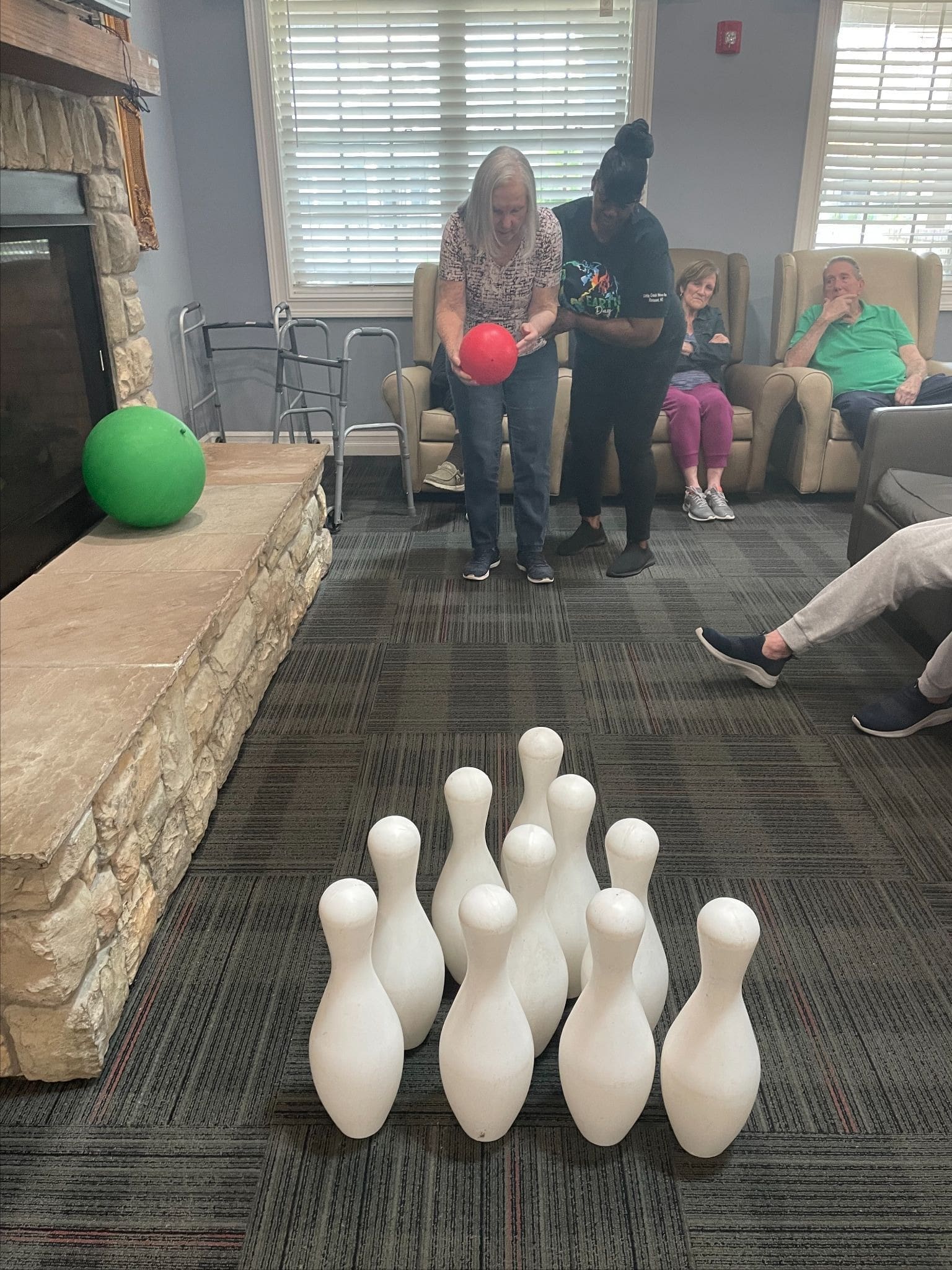
This is where our small-home model comes from. You can see it in the Dolan memory care difference and in daily life at Dolan: homes rather than a large building, staffed by long-tenured Care Partners who learn your loved one’s history, with the day shaped around comfort, familiar routines, and real engagement instead of a clinical schedule. There are porches to sit on, music and outings during the week, and quiet one-on-one time built in, because a life does not stop mattering when memory fades.
Finding memory care in St. Louis
Dolan Memory Care has walked St. Louis families through this exact decision since 1993. We run 17 small residential homes across west St. Louis County, each welcoming 6 to 11 residents, in single-story ranch homes with secure outdoor areas and no long, confusing hallways. Our nurses are on site seven days a week, and the Care Partners who look after your loved one come to know them by their stories rather than their chart.
If you are looking for memory care in St. Louis, the easiest first step is simply to visit one and see how it feels. You will know more from ten minutes in a real home than from a week of reading.
Moving to Memory Care FAQs
How do I know it’s time for memory care?
Watch for safety problems (wandering, falls, medication mistakes), needs that outpace what home care can cover around the clock, and your own health starting to give way. Any one of these is worth a conversation with your loved one’s doctor. Together they usually mean the level of care has outgrown the home.
Is it wrong to move my parent to memory care?
No. Choosing a safer place with specialized dementia support is an act of love, not abandonment. Many families find they can finally be present as family again once the constant caregiving is in trained hands.
How do I talk to my loved one about moving to memory care?
Keep it gentle and honest, and involve them as much as their memory allows. Focus on how they will feel (safe, comfortable, cared for) rather than on the diagnosis. Lean on the care team, who have had this conversation many times and can help you find the words.
You don’t have to decide alone
If today is the day you finally let yourself think about this, take a breath. Nothing has to be decided right now, and no one is going to push you.
When you are ready, schedule a tour or call us at 314-993-9500. Think of it as a conversation, not a commitment. Come see what a small memory care home feels like, tell us what you are carrying, and let us help you find the next right step for the person you love.